
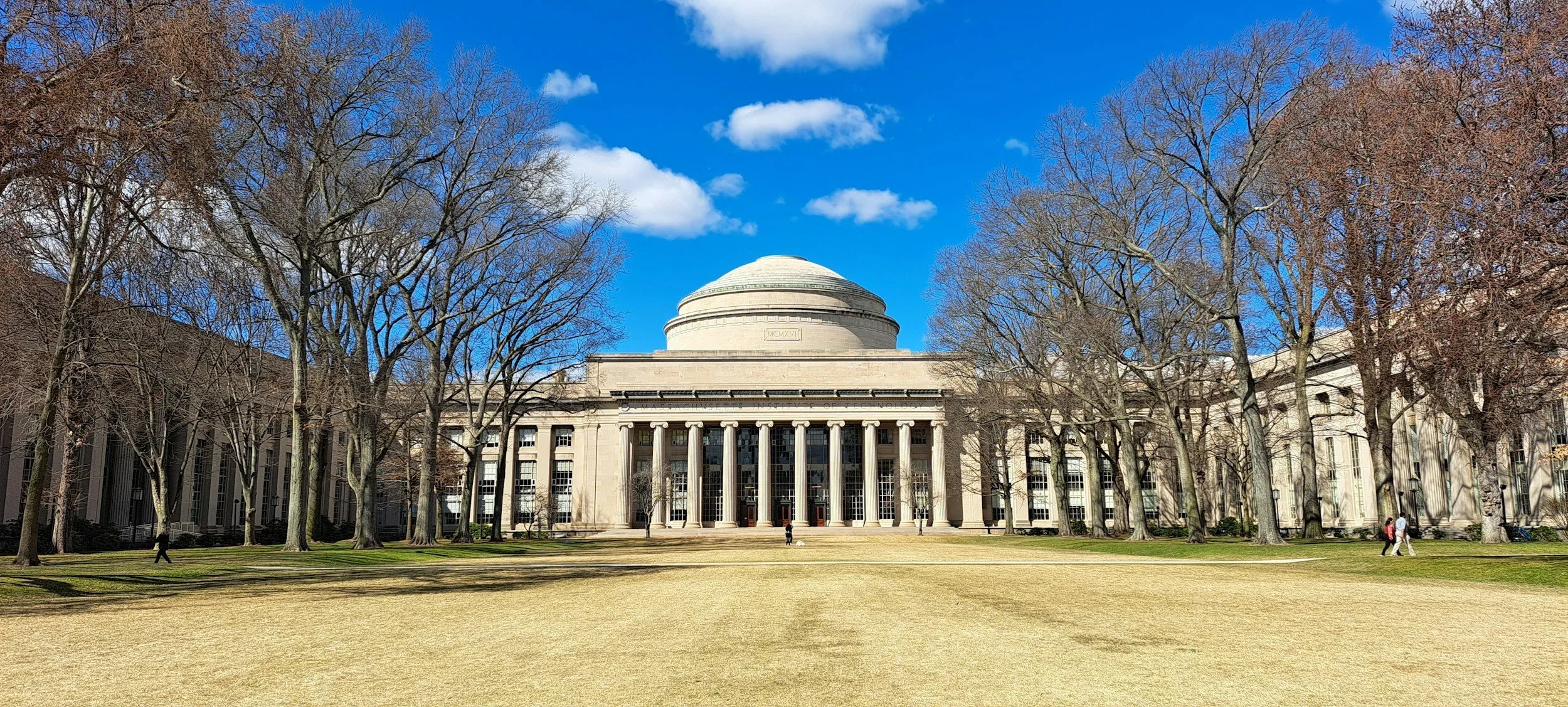
The Research Science Institute (RSI)
The pinnacle of pre-college STEM programs.
Getting into RSI practically guarantees admission to MIT and other tier-1 colleges. Here's what you need to know about the most competitive summer program in existence, and how we can help you get in.
~3%
Acceptance Rate
80-100
Students Selected Annually
0$
Cost to Attend
6
Weeks at MIT
What Makes RSI Unlike Any Other Program
RSI isn't just another summer research program. It is the summer research program, the one that admissions officers at Harvard, MIT, Stanford, and every other elite institution immediately recognize as a stamp of exceptional scientific talent.
Founded in 1984 by Admiral H.G. Rickover (the "Father of the Nuclear Navy"), RSI brings together approximately 80 of the world's most talented rising seniors each summer for six weeks of intensive research at MIT. Unlike pay-to-play programs that charge thousands of dollars, RSI is completely free, covering tuition, housing, meals, and even travel. This isn't charity; it's selectivity. RSI can afford to be free because it only accepts students who have already demonstrated they belong among the best in the world.
"RSI truly embraces the 'work hard, play hard' mentality, combining the rigor of a graduate-level research experience with the camaraderie of being surrounded by 80 of the most intellectually curious people you'll ever meet. The intensity is unlike anything I had ever experienced before."
— RSI Alumnus, Quora
🔬
Graduate-Level Research
You don't shadow a researcher, you become one. RSI students conduct original research alongside MIT professors, Stanford graduate students, Harvard faculty, and scientists at Boston's leading research institutions. Your project could form the basis of a published paper.
🎓
World-Class Mentorship
One-on-one mentorship with researchers at the pinnacle of their fields. Many RSI mentors are MIT professors, Nobel laureates, and industry leaders who have shaped their disciplines. This access simply doesn't exist anywhere else.
🌐
The Rickoid Network
RSI alumni (called "Rickoids") include 203 Regeneron STS finalists, 12 first-place winners, 15 Rhodes Scholars, 16 Marshall Scholars, and a Fields Medalist. This network lasts a lifetime, and opens doors that stay closed to everyone else.
🏆
Competition Launchpad
RSI research projects frequently win top prizes at Regeneron STS, Siemens Competition, and ISEF. The program is specifically designed to produce research that can compete at the highest levels of national and international science competitions.
The Numbers Don’t Lie
RSI's acceptance rate hovers around 2–5%, making it more selective than Harvard, MIT, Stanford, and every Ivy League school combined. Consider this: a student could theoretically be accepted to every Ivy League university and still be rejected from RSI. That's not hyperbole—it's mathematics.
Each year, over 3,000+ students apply to RSI. Of those, roughly two-thirds of accepted students come from the United States, with the remaining third selected through competitive national processes in participating countries. The competition isn't against average students, it's against the most accomplished young scientists in the world.
What RSI Actually Values in Applicants
By analyzing RSI's essay prompts and the profiles of successful applicants, a clear picture emerges of exactly what the selection committee is looking for. This isn't guesswork, it's reverse-engineering their admission criteria.
The Core Truth
RSI wants students who will "hit the ground running,” not students who need to be taught what research is, but students who have already demonstrated they can do it at a high level and are ready to operate at the frontier of human knowledge.
1. Deep Technical Mastery in a Specific Sub-Field
RSI's first essay asks applicants to identify frontier problems within sub-fields of their chosen research areas. This isn't asking what you find interesting, it's asking whether you understand your field well enough to know what problems remain unsolved and why they matter. Generic enthusiasm is worthless here. What RSI wants is evidence that you've gone deep enough to understand where the cutting edge actually is.
Successful applicants don't just name problems, they articulate why these problems matter, demonstrate familiarity with current approaches and their limitations, and show how their prior research, coursework, and independent study has prepared them to contribute to solutions. This requires genuine expertise, not surface-level interest.
2. Demonstrated Research Experience (Not Just Interest)
RSI explicitly asks applicants to describe "specific prior research/coursework/etc experiences" that have prepared them. The key word is specific. They want to know:
Technical problems you've actually solved —
Not problems you've read about, but problems you've wrestled with personally in a lab, on a computer, or through rigorous independent investigation.Scientific skills you've developed —
Hypothesis formulation, experimental design, data analysis, feature engineering, using scientific equipment competently, understanding how to identify meaningful research questions.Competition achievements —
Math Olympiad, Chemistry Olympiad, Physics Olympiad, USA Computing Olympiad, ISEF, or similar competitions that prove you can perform at an elite level under pressure.University-level coursework —
Taking AP classes isn't enough. Competitive applicants have often taken courses at actual colleges—multivariable calculus, linear algebra, organic chemistry, quantum mechanics—before their junior year.
3. Vision That Connects Personal Motivation to Global Impact
RSI's long-range goals essay isn't asking about career plans, it's asking about purpose. The selection committee wants to understand why you care about your chosen field at a visceral, personal level, and how achieving your goals will tangibly improve real people's lives.
The strongest responses begin with a vivid personal experience that motivated the applicant's interest, trace how that motivation led to specific academic and leadership activities, articulate a concrete vision for the future (not vague aspirations), and demonstrate understanding of how that vision connects to broader human needs.
4. Leadership, Creativity, and Genuine Uniqueness
RSI doesn't want a laundry list of activities. They want evidence of depth over breadth, one or two activities where you've demonstrated genuine leadership, creative problem-solving, and measurable impact. The question isn't "how many things have you done?" but "what have you actually accomplished, and what did it cost you?"
5. Authentic Desire for Challenge and Community
RSI's "Why RSI?" essay reveals three things the program values above all:
Intellectual hunger —
A genuine desire to be pushed beyond your limits, to tackle problems where failure is likely and success is earned.Collaborative spirit —
Excitement about learning from peers who are equally passionate, equally brilliant, and pursuing entirely different research directions.Reverence for mentorship —
Understanding that learning from people at the pinnacle of their fields—including Nobel laureates—is a transformative opportunity that could shape your entire career.
The RSI Experience: Six Weeks That Change Everything
RSI isn't summer camp. It's an immersion into what life as a researcher actually looks like, with all the intensity, uncertainty, and exhilaration that entails.
Week 1:
Intensive Coursework
Crash courses taught by MIT professors and Nobel laureates across cutting-edge STEM fields. Topics range from quantum computing to CRISPR gene-editing to machine learning architectures. This week establishes the intellectual foundation for your research.
Weeks 2–5:
Mentored Research
One-on-one mentorship with a scientist conducting real research at MIT, Harvard, or Boston-area institutions. You formulate hypotheses, design experiments, collect data, analyze results, and draft a comprehensive research paper, the full cycle.
Week 6:
Final Symposium
Present your findings conference-style to peers, mentors, faculty, and industry professionals. The top 10 presentations are selected by a panel of experts. This experience prepares you for academic conferences throughout your career.
Evening Lecture Series
Throughout the program, distinguished scientists deliver evening lectures, including Nobel Prize winners like Wolfgang Ketterle, Dudley Herschbach, and Phillip Sharp. Many lecturers are RSI alumni who've gone on to transform their fields.
Why Cosmic Is the #1 Firm for RSI Preparation
Most admissions consultants can tell you that RSI is competitive. Only Cosmic can actually prepare you to be competitive at RSI.
Here's the fundamental problem with other consulting firms: they staff former admissions officers and English majors. These people can help you write essays. They cannot teach you quantum mechanics. They cannot mentor you through a research project on protein folding. They cannot help you identify frontier problems in topological data analysis because they don't know what topological data analysis is.
Our Consultants Include:
A PhD physicist from Yale. A PhD biochemist from Albert Einstein College of Medicine. A PhD in literature from Duke. A software engineer from United Launch Alliance. A computational neuroscience researcher. These aren't just admissions experts, they're subject-matter experts who can actually teach you what RSI's selection committee is looking for.
What We Do That No One Else Can
-
We don't just tell you to "get research experience." We actively mentor you through research projects, teach you the methodologies used in your field, and help you understand your domain deeply enough to identify genuine frontier problems.
-
RSI asks you to choose research areas and sub-fields. Most applicants pick the most obvious choices. We help you identify sub-fields that align authentically with your prior experience while giving you the best chance of being matched with a mentor whose work excites you.
-
RSI values Olympiad performance. Our consultants have coached students to top finishes in Math Olympiad, Chemistry Olympiad, and Physics Olympiad—not just through practice problems, but through deep understanding of the underlying concepts.
-
We map out exactly which college courses you should take, when to take them, and how to demonstrate to RSI that your academic trajectory is several years ahead of your peers.
-
We help you craft essays that don't just sound smart—they demonstrate actual technical expertise. When you write about frontier problems, you'll use correct terminology, reference actual research, and show understanding that only comes from genuine study.
The Cosmic RSI Preparation Timeline
Getting into RSI isn't something you prepare for in a few months. It requires years of strategic development. Here's how we help students at each stage:
8th Grade: Foundation Building
We identify your strongest STEM interests and begin developing a focused "spike." This means choosing one or two areas to go deep rather than spreading thin. We start you on accelerated math trajectories, introduce you to competition mathematics, and help you find your first research mentors, professors willing to guide a motivated middle schooler.
9th Grade: Acceleration
You should be taking math and science courses 2–3 years ahead of grade level. We help you cold-approach professors at local universities for research opportunities, prepare for your first Olympiad competitions, and begin developing the technical vocabulary that will eventually appear in your RSI essays. Independent research projects begin here.
10th Grade (Beginning): Critical Window
This is the last point at which you can begin preparing for RSI with full strategic flexibility. By now, you should have one significant research project underway, strong Olympiad results, and be taking university courses. We refine your research focus, prepare you for summer programs that serve as stepping stones to RSI, and ensure your academic profile tells a coherent story.
11th Grade (Fall): Application Season
RSI applications are due in December. We work intensively on your essays, ensuring each one demonstrates the technical depth, personal motivation, and authentic passion that RSI demands. We help you select research areas, identify frontier problems, and articulate exactly how your background prepares you to contribute at the highest level. Every word is strategic.
Ready to Start Your RSI Journey?
96%
of our students are admitted into at least one of their top three preferred colleges.
