Villanova vs Notre Dame 2026

If you are deciding between Villanova and Notre Dame this cycle, the bottom line comes down to this. Notre Dame has become the more selective school overall and in its early round, while Villanova still gives you materially more accessible admission odds, especially once you look past its binding early decision plans. Notre Dame's own figures show its Restrictive Early Action admit rate falling from about 17.3% for the Class of 2026 to 11.8% for the Class of 2030, with overall admit rates sitting around 9% across the last two cycles. Villanova's current profile for the Class of 2030 shows a 29.6% overall admit rate, and its Common Data Set filings put early decision admit rates in the mid 50s to about 60% in recent years, though Villanova does not publish a clean regular decision rate the way Notre Dame does.
The two schools also structure their admission plans very differently, which changes how you should think about strategy. Notre Dame offers nonbinding Restrictive Early Action plus nonbinding Regular Decision, with no early decision option at all and a real restriction on applying binding early anywhere else. Villanova gives you four plans instead: Early Action and Regular Decision, both nonbinding, plus Early Decision I and Early Decision II, both binding. In practice, that means you have more strategic levers at Villanova, while Notre Dame asks for a cleaner signal from you, either show early interest through REA without a binding contract, or apply regular decision.
Admissions Selectivity
Notre Dame publishes separate REA and RD updates, so its year by year selectivity is easy to track. For the Class of 2026, 9,683 students applied REA and 1,675 were admitted, a rate of 17.3%. For the Class of 2027, 11,163 applied REA with 1,701 admitted, or 15.2%, and the overall class landed at roughly 12.5% out of more than 28,000 applicants. For the Class of 2028, REA admits fell to 15.0% out of 11,498 applicants, RD admits came in at 8.7% out of 18,445 applicants, and the inferred overall rate was about 11.1%. For the Class of 2029, 12,917 students applied REA with 1,669 admitted, a rate of 12.9%, and the overall rate across 35,401 applicants settled at about 9%. For the Class of 2030, REA applications climbed again to 13,711 with 1,617 admitted, an 11.8% rate, and the overall rate across 36,102 applicants held at 9%.
Villanova's public record is less complete, particularly on regular decision. Its Common Data Set filings report Early Decision figures consistently, but Early Action and Regular Decision numbers are harder to pin down year over year. What you can see clearly is that Villanova's binding Early Decision rounds have run dramatically higher than Notre Dame's REA, with combined ED I and ED II admit rates of 59.6% for the Class of 2021, 55.6% for the Class of 2022, and 54.2% for the Class of 2024, when 920 of 1,696 ED applicants were admitted. In the same cycle, the overall class saw 6,274 admits out of 23,256 applicants, a 27.0% rate. Villanova's Early Action round for the Class of 2023 admitted 2,266 of 14,667 applicants, or 15.5%. For the current Class of 2030 profile, Villanova reports 28,867 applicants and roughly a 29.6% overall admit rate, with a target class size of 2,000.
Two things follow from these numbers. First, Notre Dame's early round has gotten steadily harder, moving from 17.3% down to 11.8% across the 2026 to 2030 cohorts, while its overall process has settled near 9% for two cycles running. Second, Villanova's binding Early Decision remains far more favorable than Notre Dame REA on raw admit rate, but that comparison is not apples to apples. Villanova's ED requires a binding commitment, while Notre Dame's REA is nonbinding and pulls in a broader, less contractually locked in applicant pool. Because Villanova does not cleanly publish RD only figures for most years, the fairest read for you is that ED is a very strong lever at Villanova, EA is meaningfully more competitive than ED, and RD likely carries the toughest odds once early seats are filled, though that last point is an inference rather than a published statistic.
Application Timeline
Both schools open applications in August. Villanova's Early Action and Early Decision I deadlines fall on November 1, the same date as Notre Dame's REA deadline. Notre Dame follows with a November 15 deadline for supporting documents, financial aid priority materials, and SlideRoom submissions. Villanova's Early Decision I decisions come out December 15. Notre Dame's Regular Decision deadline is January 4, with supporting documents and aid priority materials due January 15, the same day Villanova's Early Decision II and Regular Decision applications are due. Villanova notifies Early Action applicants by January 20. Villanova's Early Decision II decisions arrive March 1, and Notre Dame releases its Regular Decision decisions in late March. Villanova begins rolling Regular Decision notifications April 1. Both schools share a May 1 enrollment deposit deadline.
Early Programs and How They Work
Villanova gives you four plans to choose from as a first year applicant, Early Action, Early Decision I, Early Decision II, and Regular Decision. The university is explicit that EA and RD are nonbinding while both ED rounds are binding. It also lets you change your plan mid cycle. Villanova's admissions FAQ states that the deadline to switch from Early Action to Early Decision I is November 10, and that deferred Early Action applicants or Regular Decision applicants can request a switch to Early Decision II by January 31. That flexibility rewards you if you want to signal increasing commitment as the cycle unfolds.
Notre Dame is structurally simpler. It offers only Restrictive Early Action and Regular Decision, and both are nonbinding. The restriction is real. Notre Dame's own admissions language says you may apply REA there as long as you do not also apply binding early decision anywhere else. In other words, Notre Dame wants exclusivity in the early round from you without requiring an enrollment contract, which makes REA a strong signal but a less absolute one than Villanova's ED.
The two schools also differ on application platforms. Villanova accepts the Common Application or the Coalition Application along with a Villanova specific writing supplement. Notre Dame accepts the Common Application, the Coalition Application, and the QuestBridge Application, and requires its own Notre Dame Writing Supplement, along with SlideRoom for applicable supplemental submissions. On interviews, the two schools actually converge. Neither treats interviews as part of standard first year review. Notre Dame's FAQ states plainly that interviews are not part of the evaluation process, and Villanova's Common Data Set marks interviews as not considered in first year admission. If you are used to private school admissions norms where interviews carry real weight, know that neither of these schools works that way for general applicants.
Testing and Academic Profiles
Notre Dame has been unusually transparent about its testing policy. It described the 2021 cycle as its second year of test optional admissions, confirmed in September 2022 that it would stay test optional through the 2024 application year, and now states it will remain test optional through at least the 2026-27 cycle. Notre Dame also tells you directly that it superscores both the SAT and ACT, does not require writing sections, and treats ACT science as optional.
Villanova's currently available materials show a more qualified version of test optional. Its 2025-26 Common Data Set codes the SAT and ACT as required for some applicants, with homeschooled students specifically required to submit a score. In that same filing, only 19% of enrolled first years in Fall 2025 submitted an SAT score and 9% submitted an ACT score, which lines up with a mostly test optional applicant pool in practice. Villanova's current Class of 2030 admission profile adds that 47% of admitted students were test optional.
On raw scores, Notre Dame sits a notch above Villanova, but the gap is not large. Villanova's current profile shows an SAT middle 50% of 1,440 to 1,520 and an ACT middle 50% of 33 to 35. Notre Dame's current enrolled profile for the Class of 2029 shows an SAT middle 50% of 1,460 to 1,540 and the same 33 to 35 ACT range. Earlier cycles tell a similar story. Villanova's enrolled Class of 2023 cohort showed 1,410 to 1,490 on the SAT and 32 to 34 on the ACT, with only 25% submitting SAT scores and 11% submitting ACT scores. A student newspaper report on Notre Dame's Class of 2028 cited an SAT range of 1,470 to 1,540 and an ACT range of 33 to 35 from university data.
The more interesting difference between the two schools is behavioral rather than numerical. Notre Dame has framed test optional policy as a long running, mission driven access decision that started with pandemic era testing disruptions and has since become part of a broader holistic review process. Villanova's materials show a policy that is still optional for most applicants in practice, but with less narrative emphasis around it, and with a retained requirement for certain groups such as homeschooled students.
Campus Culture and Academic Structure
Both schools are Catholic, but you should not treat them as culturally interchangeable. Villanova describes itself as an Augustinian Catholic community built around the values of truth, unity, and love. Notre Dame frames its Catholic mission as deeply woven into both academics and campus life, while emphasizing that students of all faiths are welcome. In practice, Villanova's Catholic identity reads as more community centered and Augustinian in character, while Notre Dame's feels more visibly liturgical, residential, and steeped in tradition.
Location sharpens that difference further. Villanova sits on a suburban Main Line campus 12 miles from Philadelphia, with rail access and shuttle service that make the city a real part of student life, internships, and social geography. The university is also entering a new physical phase, with its 112 acre Cabrini Campus opening in August 2026. Notre Dame, in contrast, functions as a far more self contained residential community in Notre Dame, Indiana, where official materials repeatedly frame residence halls and hall traditions, rather than a nearby city, as the center of undergraduate identity.
Academically, Villanova is more compact at the undergraduate level, organized around the College of Liberal Arts and Sciences, the College of Engineering, the Villanova School of Business, and the M. Louise Fitzpatrick College of Nursing. Notre Dame's undergraduate structure is broader, spanning Architecture, Arts and Letters, Business, Engineering, Science, and the Keough School of Global Affairs. If you are aiming at global affairs, architecture, or a highly structured residential and professional environment, Notre Dame's distinct school structure is worth weighing carefully.
Housing and social life produce the clearest cultural split between the two schools. Notre Dame reports that 100% of first years and more than 80% of upperclass students live in its 33 single sex residence halls, and it points out that there are no fraternities or sororities because the residence hall itself functions as the center of social, religious, and intramural life. Villanova's Common Data Set reports that 99% of first years and 83% of undergraduates live in university housing, but it also reports meaningful fraternity and sorority participation, with 19% of undergraduate men and 34% of undergraduate women involved in Greek life. Both campuses are heavily residential, but Notre Dame is built around the hall as the core social unit, while Villanova blends residential life with an active Greek system and easy access to the city.
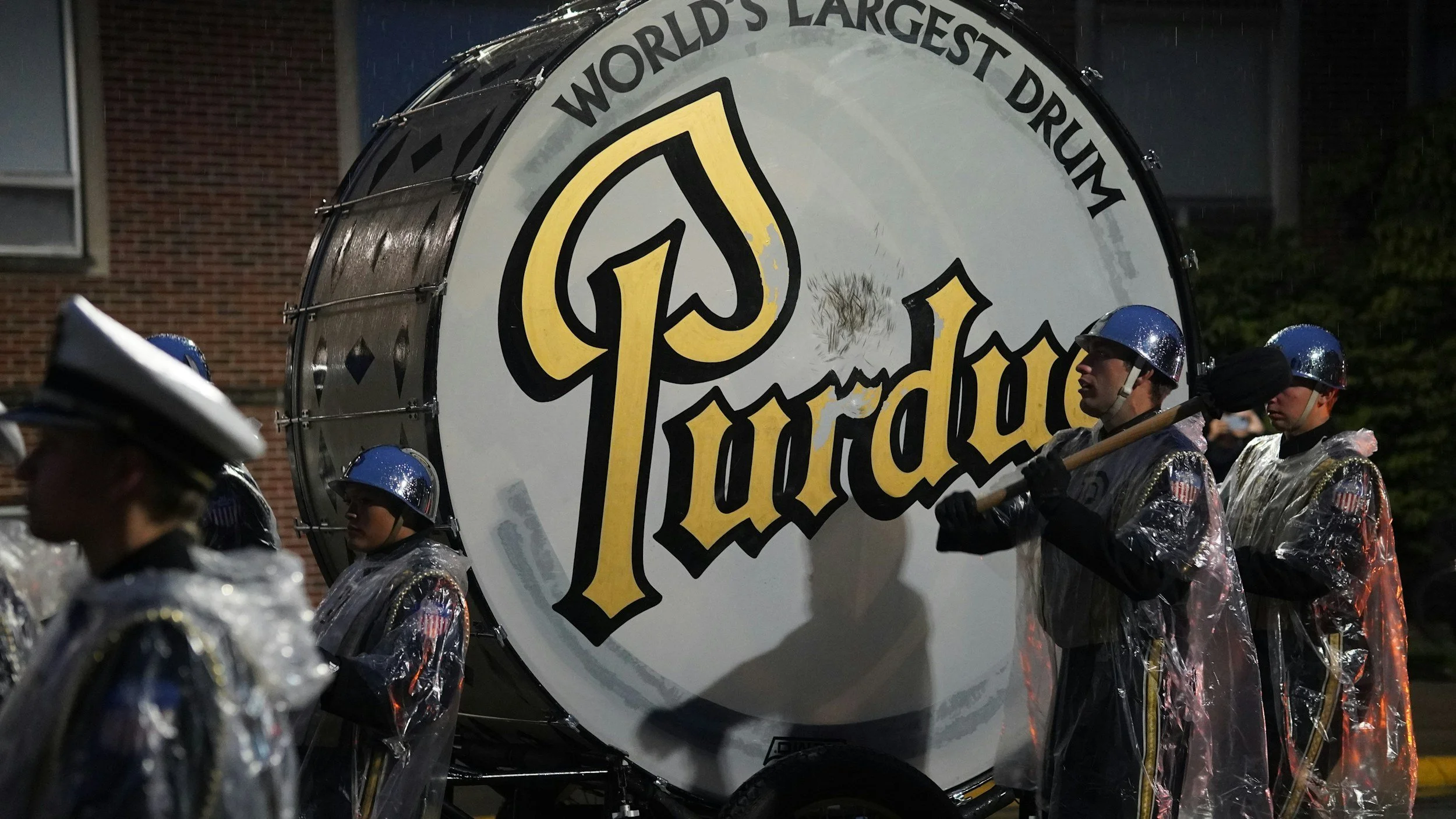
Athletics culture follows the same pattern. Notre Dame's public storytelling centers on football weekends, the marching band, campus traditions, and hall life, with admitted student programming built around full campus immersion in Notre Dame culture. Villanova fields broad Division I athletics, but its national identity is tied much more closely to men's basketball and Big East culture. If you want the full football weekend experience, Notre Dame is the clearer fit. If you want high level Division I sports energy without football sitting at the symbolic center of the school, Villanova will feel different in a way that matters.
Political climate is harder to quantify from official sources alone, and that limitation is worth stating directly to you. What the public materials do show is that Notre Dame's student government formally supports cross partisan civic engagement through a Council for Civic Engagement, suggesting a campus where political conversation is active but channeled toward dialogue. Villanova's public materials emphasize mission, student organizations, service, and Greek life more than any explicit ideological branding. Both campuses almost certainly include real political diversity, but Notre Dame's Catholic identity and civic dialogue infrastructure make national moral and political questions somewhat more institutionally visible.
Trends Since 2021
The clearest Notre Dame trend from 2021 to 2026 is that selectivity and enrollment power rose together. REA applicants grew from 9,683 for the Class of 2026 to 13,711 for the Class of 2030, while the early admit rate fell from 17.3% to 11.8%. Over the same window, yield climbed from about 60% for the Classes of 2026 and 2027 to 62% for the Class of 2028 and 64% for the Class of 2029. That is the profile of a school becoming both more desirable and harder to get into at the same time.
Notre Dame's policy shifts have tracked its mission rather than serving as purely tactical moves. Its 2021 and 2022 admissions materials tied test optional extensions directly to pandemic era testing barriers. By 2024 through 2026, the story widened into affordability, with the university connecting its messaging to Pathways to Notre Dame, first highlighted during the 2024-25 cycle and then expanded in March 2026 so that families earning under $150,000 pay zero tuition and families under $200,000 receive at least half tuition support. That change is likely to strengthen yield further, especially among upper middle income families who might otherwise have compared Notre Dame unfavorably on net price.
Villanova's trend line looks more mixed. It remains highly attractive and clearly selective, but its own materials show a school still operating within tighter aid constraints than Notre Dame, and Villanova states directly that it does not currently meet 100% of demonstrated financial need. At the same time, overall demand remains strong, with 28,867 applicants and a 29.6% admit rate for the Class of 2030, and the 2026 opening of the Cabrini Campus signals real institutional expansion. There is also evidence that Villanova has leaned into early decision as an enrollment management tool over this period, having added a second Early Decision round for fall 2021 after early success with its first round, a strategy Notre Dame has not needed in order to raise its own yield.
Cost and Financial Aid
For the 2026-27 academic year, Villanova's tuition is $72,990, with a $1,024 student services fee and average housing and food costs of $10,314 and $9,040. Villanova does not currently meet 100% of demonstrated financial need, though 65% of full time undergraduates receive some form of aid, with an average grant of $42,088 and a total cost of attendance around $96,886 once indirect costs are included. Notre Dame's 2026-27 direct charges come in slightly lower on tuition at $69,280, with a $514 mandatory fee and housing and food costs of $18,992. Notre Dame meets 100% of demonstrated need, admits students need blind, and does not include loans in its need based aid packages. Under its expanded Pathways to Notre Dame program, families earning under $150,000 pay zero tuition, and families earning up to $200,000 receive at least half tuition support, with 70% of Notre Dame students receiving some form of aid.
The practical takeaway for you is straightforward. Villanova is now slightly more expensive on sticker tuition, while Notre Dame is far more aggressive on grant based affordability for families who qualify for need based aid. If your family is full pay, the two schools sit in roughly the same private Catholic cost range. If you are likely to qualify for aid, especially below the upper middle income band, Notre Dame's 2026 Pathways expansion changes the financial comparison in a real way.
If you want to learn what you can do right now to optimize your application for either Notre Dame or Villanova, schedule a free consultation with an admissions expert today.