Columbia vs University of Chicago 2026
Columbia University and the University of Chicago are two of the most intellectually demanding undergraduate institutions in the country. Both require you to complete a rigorous core curriculum, both attract students who genuinely love ideas, and both sit at the very top of the selectivity ladder. But they are not interchangeable. The city you live in, the structure of your daily academic life, and even the way the admissions office approaches its incoming class differ in meaningful ways. Here is what the data actually says, and what it means for your decision.
Selectivity: How Hard Are These Schools to Get Into?
Columbia is brutally selective and has remained so with remarkable consistency. Across the entering classes of Fall 2021 through Fall 2024, Columbia's overall acceptance rate held in a narrow band between 3.75% and 3.89%. If you apply Early Decision, your odds improve significantly but are still daunting. Columbia's ED acceptance rate ranged from roughly 11.6% to 13.3% across those same years, while the derived Regular Decision acceptance rate hovered closer to 2.7% to 2.9%. That gap is real, and it matters for your strategy.
The University of Chicago has been moving in one direction: down. Its acceptance rate dropped from 6.48% for the Fall 2021 entering class all the way to 4.48% for Fall 2024. That is a two percentage point decline in just four years, driven by a surge in applications from 37,974 to 43,612 over the same period. If you have heard that UChicago is somehow easier to get into than Columbia, that story is increasingly outdated.
One number that separates these two schools in a surprising way is yield. Columbia's yield, meaning the share of admitted students who choose to enroll, sat between 62% and 66% across this period. UChicago's yield climbed from 83% in 2021 to 88% by 2024. A yield in the high 80s is extraordinary for a school of this academic profile. It suggests that students who get in are overwhelmingly choosing UChicago as their top choice, which in turn signals something meaningful about the school's distinct identity and the self-selection of applicants who apply there.
Early Application Structure
Columbia offers a single binding Early Decision plan with a deadline around November 1 and notification in mid-December. If you apply ED and get in, you are committing to attend.
UChicago offers five total application rounds: ED 0, ED I, ED II, Early Action, and Regular Decision. Duke offers two: Early Decision and Regular Decision.
The newest of UChicago's early rounds is ED 0, officially called the Summer Student Early Notification option (SSEN). First introduced for the Class of 2029, SSEN allows students who attended a UChicago Summer Session program to apply between September 1 and October 15 and receive a binding decision before November 1. That means one cohort of students is already locked in before ED I applicants elsewhere have even hit submit. After ED 0 comes EA and ED I in November, then ED II in January, and finally Regular Decision.
The result is that UChicago's class is largely spoken for before RD opens. UChicago's admissions committee overwhelmingly fills its incoming class with ED 0, ED I, ED II, and EA applicants, producing a yield rate higher than even Harvard. With yield sitting in the high 80s percent range across three binding rounds, Regular Decision at UChicago is not a meaningful second pathway. It is a leftover pool.
Standardized Testing
Both schools are test-optional in practice, meaning scores are considered if submitted but not required. Among students who did submit scores, the ranges at both schools are nearly identical. For the Fall 2024 entering class, enrolled students at both Columbia and UChicago posted SAT composite ranges of 1510 to 1560 (25th to 75th percentile), with medians around 1540. ACT composites were similarly tight, with 25th percentiles at 34 and 75th percentiles at 35 or 36 depending on the school and year.
If you have a strong score, submitting it almost certainly helps at both schools. If your score is below the 25th percentile, you should think carefully about whether to submit.
The Core Curriculum: Shared but Distinct
Both Columbia and UChicago are famous for their cores, and both institutions treat the core as a point of institutional pride rather than a bureaucratic requirement. But the two cores feel quite different in practice.
Columbia's Core is built around shared seminar sequences. Literature Humanities, Contemporary Civilization, Art Humanities, Music Humanities, and Frontiers of Science form the backbone of the experience. The goal is to give every Columbia undergraduate a common intellectual vocabulary. You and your classmates will have read the same texts, argued over the same questions, and come away with a genuinely shared set of reference points. The Global Core adds an additional structured component beyond the classic sequence.
UChicago's Core is broader in scope, spanning nine categories across the Arts, Humanities, Civilization Studies, Social Sciences, Biological Sciences, Physical Sciences, and Mathematical Sciences. The whole thing adds up to roughly 15 to 16 courses. Writing and inquiry are threaded throughout, particularly in the Humanities and Social Sciences sequences, and the emphasis is less on shared canonical texts and more on disciplined ways of thinking across different fields. UChicago's intellectual identity has always been built around rigorous argument and analysis, and the Core reflects that.
Neither approach is better. Columbia's Core will feel more immersive if you love the humanities seminar format. UChicago's Core will feel more expansive if you want structured exposure across the full range of academic disciplines.
What Students Are Actually Studying
UChicago's Common Data Set includes a breakdown of bachelor's degrees conferred by discipline for the 2020 to 2021 academic year. Social Sciences dominated at 33.6% of degrees, followed by Mathematics and Statistics at 10.6%, Biological and Life Sciences at 7.9%, Physical Sciences at 7.5%, and Computer and Information Sciences at 6.0%. This is a useful proxy for where UChicago students actually end up, and it confirms the school's reputation as a place where economics, social thought, and quantitative fields are particularly strong.
Location: New York City vs Hyde Park
This is one of the most consequential differences between the two schools, and it does not show up in rankings.
Columbia sits in Morningside Heights in Manhattan. The 1 train runs from the front gate. You can be in Midtown in 20 minutes, in lower Manhattan in 30. Internship access is immediate and unrivaled. If you are drawn to finance, media, publishing, fashion, tech, or any industry with a significant New York presence, Columbia puts you inside the network from day one.
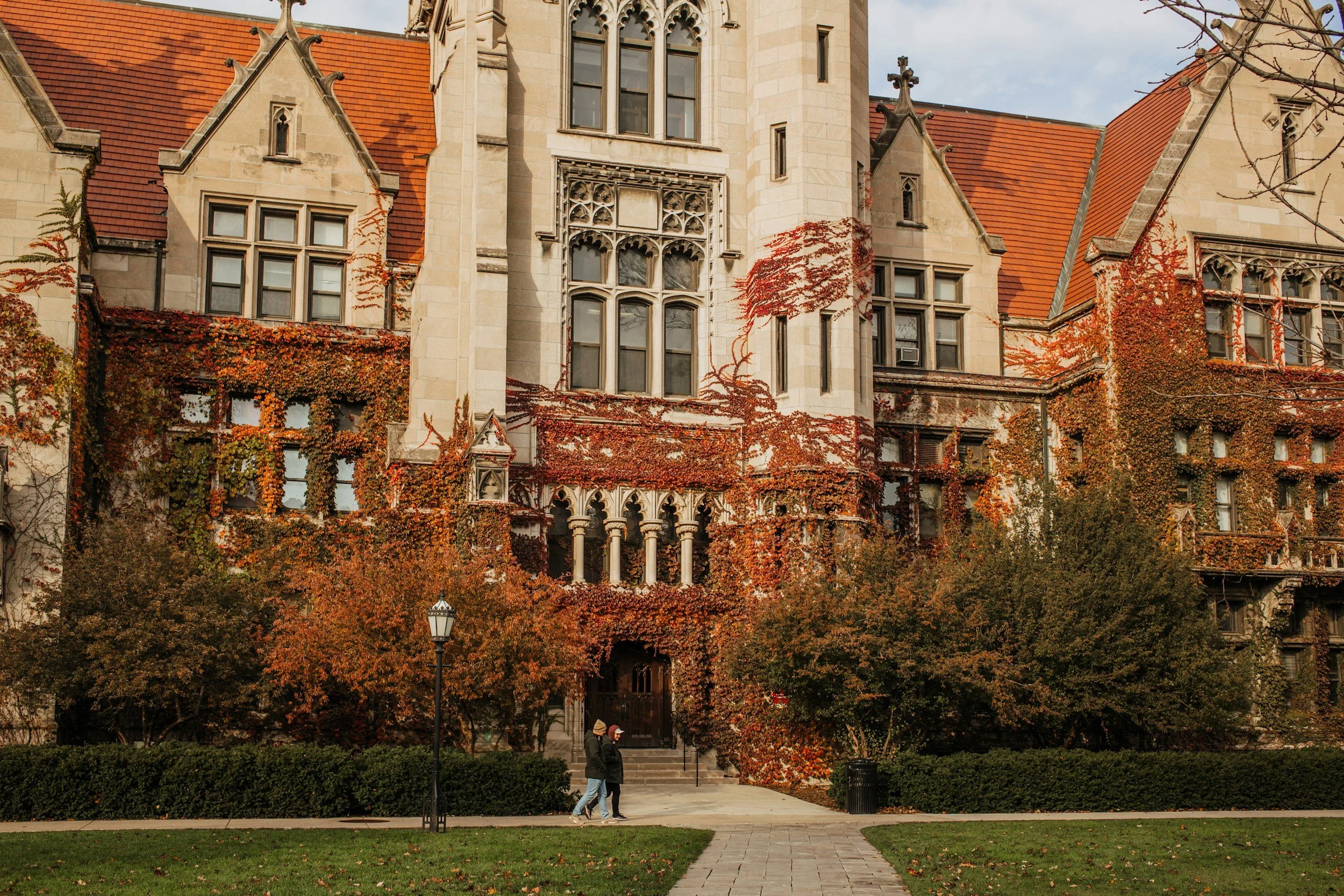
UChicago is in Hyde Park, a campus-centered neighborhood on Chicago's South Side. It is not remote, but it is not a grid-connected urban campus the way Columbia is. The university runs its own shuttle system, and students use the Chicago Transit Authority for longer trips into the city. The campus itself is architecturally beautiful and academically intense, but if you are expecting constant city immersion, the day-to-day texture is different from what you would get in New York.
Neither setting is inferior. If you want to be embedded in the largest city in the country with direct access to virtually every industry, Columbia has an advantage. If you want a more campus-centric intellectual community where the university is the center of gravity, UChicago delivers that more fully.
Cost of Attendance
The sticker prices are nearly identical. For the 2025 to 2026 academic year, Columbia's tuition comes in at $70,170 with required fees of $3,280 and food and housing costs of $20,322. UChicago's tuition is $71,325, with required fees of $1,941 and food and housing of $20,835. Both schools land in the mid-$90,000 range when you add those line items together.
The real difference shows up in financial aid. Students on Reddit who chose between these two schools in recent years frequently cited aid packages as the deciding factor, with some reporting annual cost differences of $20,000 or more depending on their financial profile. If you receive offers from both schools, compare the net price carefully before making any decision based on prestige or rankings.
Campus Life and Student Culture
Both schools draw heavily from out of state. UChicago reported 83% of its Fall 2021 entering class coming from outside Illinois, while Columbia reported 68% from outside New York. Both schools house the vast majority of first-year students on campus, which builds a strong residential community in the first year regardless of how urban the surrounding neighborhood is.
Greek life exists at both schools but operates differently. Columbia has 19 recognized fraternities and sororities with over 1,100 student members across Columbia College, Engineering, General Studies, and Barnard. UChicago has more than 20 Greek organizations, though most fraternities house off-campus and the sororities typically do not have houses. Neither school is a traditional Greek-dominant social environment.
The "UChicago has no social life" narrative that circulates on college forums is genuinely contested by current students. The workload is real and the academics are intense, but students regularly push back on the idea that social life does not exist there. The more accurate framing is that both schools attract students who are genuinely excited to do hard intellectual work, and both have active extracurricular ecosystems alongside the academic pressure.
Mental Health Resources
Both schools offer short-term individual counseling, psychiatric consultation, group therapy, and emergency intervention services. Columbia's Counseling and Psychological Services handles stress, anxiety, depression, academic concerns, and relationship issues through a solution-focused model. UChicago Student Wellness provides similar services with a 24/7 therapist-on-call number for urgent mental health needs.
How to Think About This Decision
If you are trying to decide between Columbia and UChicago, the data makes one thing clear: these are peers in selectivity, academic rigor, and cost. The choice comes down to fit in a way that is unusually personal.
Columbia makes more sense if you want to be in New York City, if your career is tied to industries where New York proximity is a genuine advantage, or if the seminar-style shared humanities core sounds more appealing to you than a broader distribution structure.
UChicago makes more sense if you want a campus-centered intellectual community with an exceptionally strong culture around argument and analysis, if you are drawn to economics, social sciences, or quantitative fields where UChicago's faculty and alumni networks are particularly powerful, or if the non-binding Early Action option is attractive to you from a strategic standpoint.
If you want to learn what you can do right now to optimize your application for either Columbia or University of Chicago, schedule a free consultation with an admissions expert today.