CS at UIUC vs CS at Carnegie Mellon 2026
If you are deciding between the University of Illinois Urbana-Champaign and Carnegie Mellon University for a CS degree, you are comparing two of the most respected undergraduate computing programs in the country. They are not interchangeable. They have different organizational structures, different curriculum philosophies, different admissions profiles, and different cultures. This guide breaks down what actually matters so you can figure out which one is the better fit for you.
How Each Program Is Organized
Understanding the organizational structure of each program helps you understand everything else, including how research works, how specialization works, and what kind of community you will be embedded in.
At UIUC, the CS major sits within the Siebel School of Computing and Data Science, which is housed inside the Grainger College of Engineering. The Siebel School was formalized in 2024 following a $50 million gift from Thomas M. Siebel. Crucially, the Siebel School has no internal departments. Instead, it is organized around research areas. This means faculty cluster by interest rather than by departmental affiliation, which gives the school a somewhat flatter, more integrated feel. You are admitted directly into a specific program (either "Computer Science" or one of the "CS+X" blended programs), and your home is Grainger Engineering from day one.
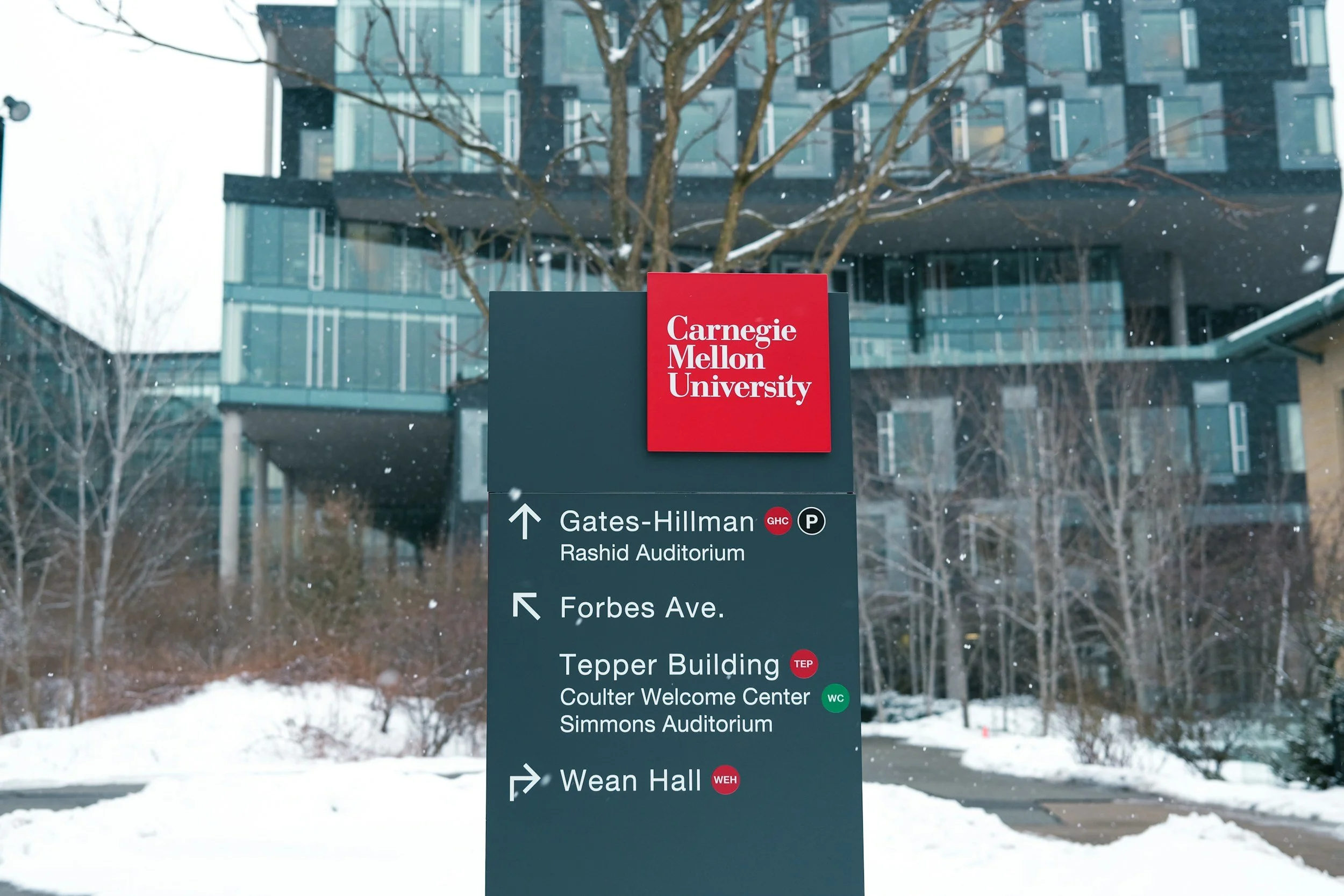
At CMU, the CS major sits within the School of Computer Science, which is organized as a collection of degree-granting departments. SCS houses seven departments: the Computer Science Department, the Machine Learning Department, the Robotics Institute, the Human-Computer Interaction Institute, the Language Technologies Institute, the Ray and Stephanie Lane Computational Biology Department, and the Software and Societal Systems Department. SCS also offers five distinct bachelor's degrees: CS, AI, computational biology, HCI, and robotics. Incoming students enter SCS without declaring a specific major and formally select one during the second half of their second semester. If you are targeting the CS degree specifically, you will be in the Computer Science Department, but you will spend your first year in a broader SCS environment surrounded by future robotics engineers, AI majors, and HCI students.
Curriculum: What You Are Actually Required to Study
Both programs are rigorous and technically demanding. But they are built differently.
UIUC's B.S. in Computer Science is a 128 credit-hour degree. The technical core is extensive and engineering-flavored. It includes an introductory programming sequence, discrete mathematics, data structures, software design, computer architecture, systems programming, numerical methods, probability and statistics for CS, algorithms and models of computation, and programming languages and compilers. On top of that, UIUC requires university physics through electricity and magnetism, reflecting its home in an engineering college. The general education requirements are met through standard campus-wide coursework rather than a formally structured humanities distribution.
CMU's B.S. in CS is a 360-unit degree. The core includes imperative and functional programming, parallel and sequential data structures and algorithms, introduction to computer systems, theoretical CS, and algorithm design and analysis. CMU also formally requires six mathematics and probability courses, covering calculus, linear algebra, discrete math, and probability. Where CMU's curriculum is most distinctive is in its general education structure: SCS requires a minimum of 63 units in humanities and arts and 36 units in science and engineering, distributed across specific thematic areas. This is not a soft suggestion. It is a formal distribution requirement built into the degree architecture.
The single biggest structural difference between the two programs is what happens after the core. At UIUC, you specialize by choosing at least three technical electives from a single focus area within CS. The catalog lists focus areas covering software foundations, algorithms and models of computation, intelligence and big data, systems, security, and several others. Specialization is primarily intra-CS: you go deep within the discipline. At CMU, you are required to take at least one course each in logics and languages, software systems, artificial intelligence, and domains, creating enforced breadth across CS subfields. On top of that, CMU requires a full SCS concentration or a non-CS minor, typically five to six courses. In practice, this means most CMU CS students graduate with a meaningful secondary focus: economics, mathematics, design, statistics, or a defined area within SCS itself. If you want a CS degree that is integrated with a second field at a structural level, CMU builds that in. If you want to go extremely deep in one CS subfield without that requirement, UIUC gives you more room to do that.
Research: Two Different Models
Both UIUC and CMU are serious research institutions. But they are organized differently, and that affects how undergraduate research actually works.
At UIUC, the Siebel School's research is organized into broad areas: architecture, compilers, and parallel computing; AI; bioinformatics and computational biology; data and intelligent systems; interactive computing; programming languages, formal methods, and software engineering; security and privacy; systems and networking; and theory and algorithms. The school also maintains a large footprint of corporate and interdisciplinary partnerships, including the Amazon-Illinois Center on AI for Interactive Conversational Experiences, the IBM-Illinois Discovery Accelerator Institute, and the National Center for Supercomputing Applications. For undergraduates, the school has structured programs specifically designed to create research entry points, including a Directed Reading Program, a "Trick or Research" initiative, and a summer research program. The institutional posture here is that undergraduate research should be visible and accessible, not a hidden track reserved for a small elite.
At CMU, research is department-forward. Because SCS has entire departments dedicated to machine learning, robotics, HCI, and language technologies, the depth within each subfield is exceptional. If you want to do NLP research, there is a Language Technologies Institute. If you want robotics, there is the Robotics Institute. This is not a general CS department that also has some ML people. These are specialized research environments with focused faculty clusters. CMU also uses a center overlay model: CyLab, for example, is a university-wide security and privacy institute that coordinates research across departments and can serve as an umbrella for undergraduate research projects. For undergraduates, CMU SCS structures research participation primarily through independent study and honors thesis tracks, and offers funded summer research programs to make those experiences financially viable.
The practical implication: if you want broad exposure to a large-scale, multi-industry research ecosystem and clear on-ramps as an undergrad, UIUC's structure is designed with you in mind. If you want access to the deepest possible research environment in a specific CS subfield, particularly ML, robotics, or HCI, CMU's departmental structure may offer something UIUC simply cannot match at the same level of concentration.
Admissions: What the Numbers Actually Say
UIUC is unusually transparent about CS admissions, which makes a precise comparison possible.
For the 2025 first-year cycle, UIUC published the following program-specific admit rates: Computer Science came in at 7.4%, and the CS+X blended programs came in at 17.4%. For context, Grainger Engineering overall admitted 21.2% of first-choice applicants, and the total university admit rate was 36.6%. For Grainger students who enrolled, the middle 50% GPA range was 3.89 to 4.00, the SAT range was 1480 to 1550, and the ACT range was 33 to 35.
CMU's admissions picture is less granular. For Fall 2025, CMU received 34,867 applications and admitted 3,859 students, implying an overall admit rate of roughly 11.1%. For enrolled students, CMU's test score profile showed SAT composite 25th and 75th percentile scores of 1500 and 1560, with an ACT composite range of 34 to 36. CMU does not publish a formal admit rate for SCS specifically, and figures that circulate in forums are estimates rather than university-published statistics. What is documented clearly is that CMU's overall admit rate is highly competitive, and SCS is understood to be among the most selective programs on campus.
The key takeaway: UIUC CS at 7.4% is significantly more selective than the overall university, and you should evaluate your application through that lens rather than UIUC's headline admit rate. CMU's overall selectivity is documented, but SCS-specific figures are not formally published. Do not rely on community estimates as official data.
Student Culture: What Forum Evidence Actually Tells You
Student culture is messy to compare, and forum evidence reflects selection bias. People who had extreme experiences, positive or negative, write the most. With that caveat clearly stated, some patterns are consistent enough to be worth discussing.
At CMU, the most frequently recurring theme in student discussions is workload intensity. This is not just a claim that the coursework is hard. It is a claim that heavy schedules can be socially normalized and even valorized within the campus culture. Students describe an environment where long work sessions are expected, and where the norms of peer interaction can reinforce rather than moderate academic stress. At the same time, a meaningful counter-narrative exists: many SCS students describe their peers as genuinely collaborative rather than competitive, and report positive experiences working with classmates. These two observations are not mutually exclusive. You can be in a normatively intense environment and still have cooperative day-to-day relationships. The weight of forum evidence suggests that if you are sensitive to stress culture as a social norm, CMU requires some intentionality to manage.
At UIUC, the recurring themes are different. The academic environment is frequently described as collaborative rather than zero-sum, with grading structures that do not force students to compete against each other for scarce A grades. At the same time, students also describe pockets of status signaling and elitism, particularly within certain student organizations and recruiting circles, where social comparison around internships and prestige can be intense. This duality is consistent: UIUC as a whole is pluralistic, with many coexisting subcultures, but the CS-specific subculture in certain corners can carry its own form of social pressure.
The environmental context matters too. UIUC is a college town. The campus is the social center of gravity, and there is a large, broad social environment that extends well beyond CS. If you want to interact with students from many different backgrounds and disciplines on a daily basis, UIUC's size works in your favor. CMU is in Pittsburgh, a real city with museums, neighborhoods, and a professional culture. The city has genuine appeal. The question is whether you will actually have the bandwidth to use it given CMU's academic demands.
How to Think About the Choice
If you are choosing between these two programs, here are the questions that should drive your decision.
Do you want to double down on one CS subfield at an elite research level, or do you want breadth across CS plus a second domain? CMU builds in a non-CS minor or concentration and enforces distribution across CS subfields. UIUC lets you go deep within CS without that structural requirement.
Are you drawn to the ML, robotics, or HCI research environments specifically? CMU's departmental structure gives you access to dedicated institutes for each of those areas in a way that is genuinely different from a general CS research area.
How do you respond to normatively intense academic environments? If being surrounded by peers who work extremely hard motivates you, CMU's culture can be energizing. If it creates unsustainable pressure, that is worth weighing seriously.
Do you want a large, pluralistic campus social environment, or a more concentrated, academically homogeneous one? UIUC's scale means you will encounter many kinds of people. CMU's environment is smaller and more technically focused.
If you want to learn what you can do right now to optimize your application for either UIUC or Carnegie Mellon, schedule a free consultation with an admissions expert today.