Princeton vs Stanford 2026

When students and families ask us to compare Princeton and Stanford, they're usually asking one of two questions: "Which one is harder to get into?" or "Which one is a better fit?" The honest answer is that both questions matter, and the answers might surprise you.
Admissions: How Selective Are They Really?
Let's start with the numbers. For the Fall 2024 entering class, Stanford received 57,326 applications and admitted 2,067 students, translating to an acceptance rate of approximately 3.61%. Princeton received 40,468 applications and admitted 1,868 students, for an acceptance rate of approximately 4.62%. By that measure, Stanford is meaningfully more selective.
But the yield data tells an equally important story. Of the students Stanford admitted, about 81.9% chose to enroll. At Princeton, that figure was 75.5%. Yield, the percentage of admitted students who actually say yes, is one of the clearest signals of a school's desirability relative to its peers. Stanford's higher yield suggests it wins more cross-admit battles: when a student gets into both, they're more likely to choose Stanford.
For the Class of 2029 (students entering in Fall 2025), Princeton's acceptance rate ticked down slightly further, with approximately 42,303 applicants and 1,868 admitted, around 4.42%. The trend at both institutions is consistent: applicant pools grow, admit rates compress, and competition intensifies.
Early Action: What You Need to Know
Neither Princeton nor Stanford offers binding Early Decision, a crucial distinction for families weighing strategy. Both run restrictive Early Action programs, meaning you can apply early without committing, but you're restricted from applying to other private universities' early programs simultaneously.
Princeton's program is called Single-Choice Early Action (SCEA). Stanford's is called Restrictive Early Action (REA). Under Stanford's REA policy, applicants may not apply to any other private college or university's early action or early decision plan, with limited exceptions. Princeton's SCEA operates similarly in spirit.
Both schools set their early application deadline at November 1st. Princeton releases early decisions in mid-December; Stanford releases them on December 15th. Regular decision deadlines fall in early January at both schools, with notifications coming by late March or early April and a May 1st enrollment reply deadline.
Testing Policies: A Temporary Divergence
Both Princeton and Stanford went test-optional during the pandemic era, but they're returning to required standardized testing on different timelines, and that matters for students planning ahead.
Stanford already reinstated testing beginning with the 2025–26 application cycle. Princeton is staying test-optional through the 2025–26 and 2026–27 cycles and won't require standardized testing again until the 2027–28 cycle, for Fall 2028 entry.
What does this mean in practice? If you're applying to Stanford in 2025 or beyond, prepare to submit scores. If you're applying to Princeton in the next couple of cycles, submission remains optional, though the data suggests that most enrolled students at both schools still submit scores even when not required to.
For the Fall 2024 entering class, 56% of Princeton enrollees submitted SAT scores and 21% submitted ACT scores. At Stanford, 50.3% submitted SAT scores and 19% submitted ACT scores.
Score distributions at both schools are nearly identical. At the 25th and 75th percentile benchmarks for Fall 2024 enrollees: SAT Composite ranged from 1500 to 1560 at Princeton and 1510 to 1570 at Stanford. SAT Math ranged from 770 to 800 at both schools. ACT Composite ranged from 34 to 35 at both schools. These distributions are so similar that test scores alone will not differentiate your application at either institution, context, achievement, and narrative matter far more.
Curriculum: Two Different Visions of Undergraduate Education
This is where Princeton and Stanford diverge most fundamentally, and where fit becomes the right lens.
Princeton's undergraduate program is built around independent scholarship. Every undergraduate completes independent work, A.B. students write a senior thesis; B.S.E. students complete an independent research project. Junior independent work precedes the senior thesis, and the Writing Seminar in the first year is universal. Princeton's educational model is, at its core, a writing-and-research spine: the idea is that you don't just study a subject, you contribute to it.
Stanford's undergraduate program is organized around what it calls the "Ways of Thinking/Ways of Doing" framework, 11 courses spread across 8 broad areas of inquiry that form the core of its general education requirements. Stanford operates on a quarter system rather than a semester system, which means a faster academic cadence and more modular course sequencing. Research opportunities are abundant, but they're distributed across a large, flexible ecosystem rather than structured into a universal thesis requirement.
In simple terms: Princeton's default education deepens through structured independent scholarship. Stanford's default education broadens through structured exploration. Neither is better, they serve different kinds of learners. The student who thrives at Princeton often has a clear intellectual passion they want to pursue rigorously. The student who thrives at Stanford often wants the flexibility to follow curiosity across disciplines.
Campus Culture and Institutional Ethos
Both schools describe themselves as committed to holistic admissions, academic excellence, and diversity, but their public-facing identities tilt in different directions.
Princeton's admissions narrative centers on scholarly formation: writing, independent thinking, and the experience of original research as an undergraduate. There's an emphasis on producing scholars, not just graduates.
Stanford has been more explicitly vocal in the post–Supreme Court landscape about diversity outcomes, outreach strategy, and the legal frameworks governing its admissions practices. Stanford published preliminary enrollment data for recent entering classes specifically because of national interest following the Supreme Court's 2023 affirmative action ruling, acknowledging that representation of some groups declined while committing to legally permissible recruitment efforts.
Both schools describe academic excellence as the primary admissions criterion. Both describe diversity as educationally valuable. But their institutional voices differ in emphasis, Princeton's is more internally focused on scholarly identity, Stanford's more externally focused on its role within a broader national conversation.
Location: Northeast Corridor vs. Silicon Valley
Princeton sits in Princeton, New Jersey, well within the Northeast corridor, with access to New York City and Philadelphia. Its campus is defined by gothic architecture, green quads, and a walkable collegiate town.
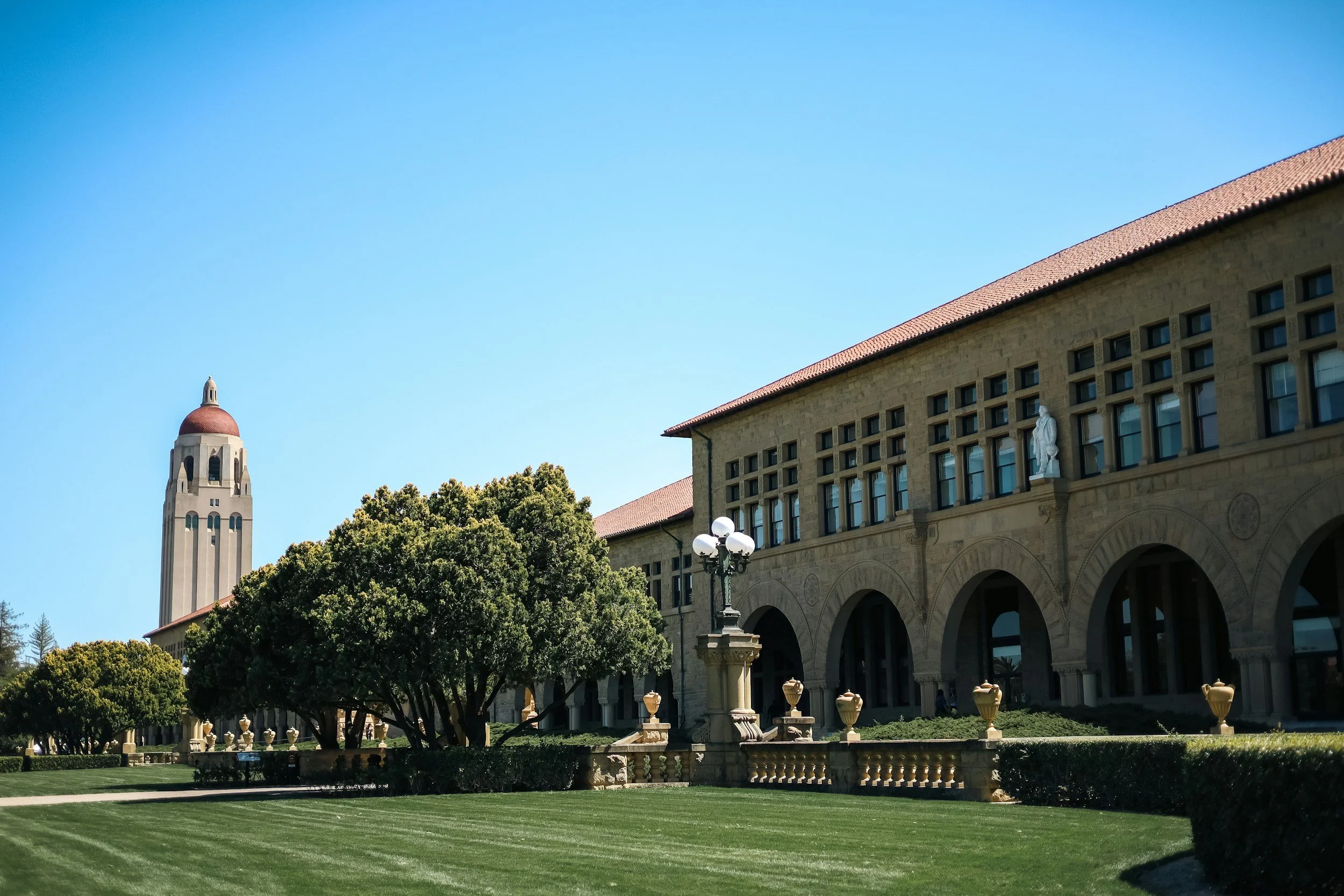
Stanford is located in Stanford, California, adjacent to Palo Alto in the heart of Silicon Valley. The Bay Area's climate is mild year-round, with very low summer rainfall and a dry-summer pattern that differs dramatically from New Jersey's four-season weather.
Location matters more than students often admit. It shapes internship access, alumni networks, recruiting pipelines, and the ambient culture of the school. Stanford's Silicon Valley proximity has cemented it as the default destination for students pursuing tech entrepreneurship and venture-backed careers. Princeton's proximity to New York makes it a natural pipeline to finance, law, and the humanities-adjacent professions, though both schools place students everywhere.
The Bottom Line
If you're asking which school is harder to get into: Stanford, by admit rate. If you're asking which school is the better fit: that depends entirely on you.
Choose Princeton if you're drawn to deep independent research, writing-intensive scholarship, and a more intimate intellectual community anchored in the liberal arts and sciences. Choose Stanford if you want flexible breadth, proximity to the tech and entrepreneurship ecosystem, and a larger research university where you can pursue almost anything across a modular quarter system.
If you want to learn what you can do right now to optimize your application for either Princeton or Stanford, schedule a free consultation with an admissions expert today.