Dartmouth Common Data Set 2025-2026
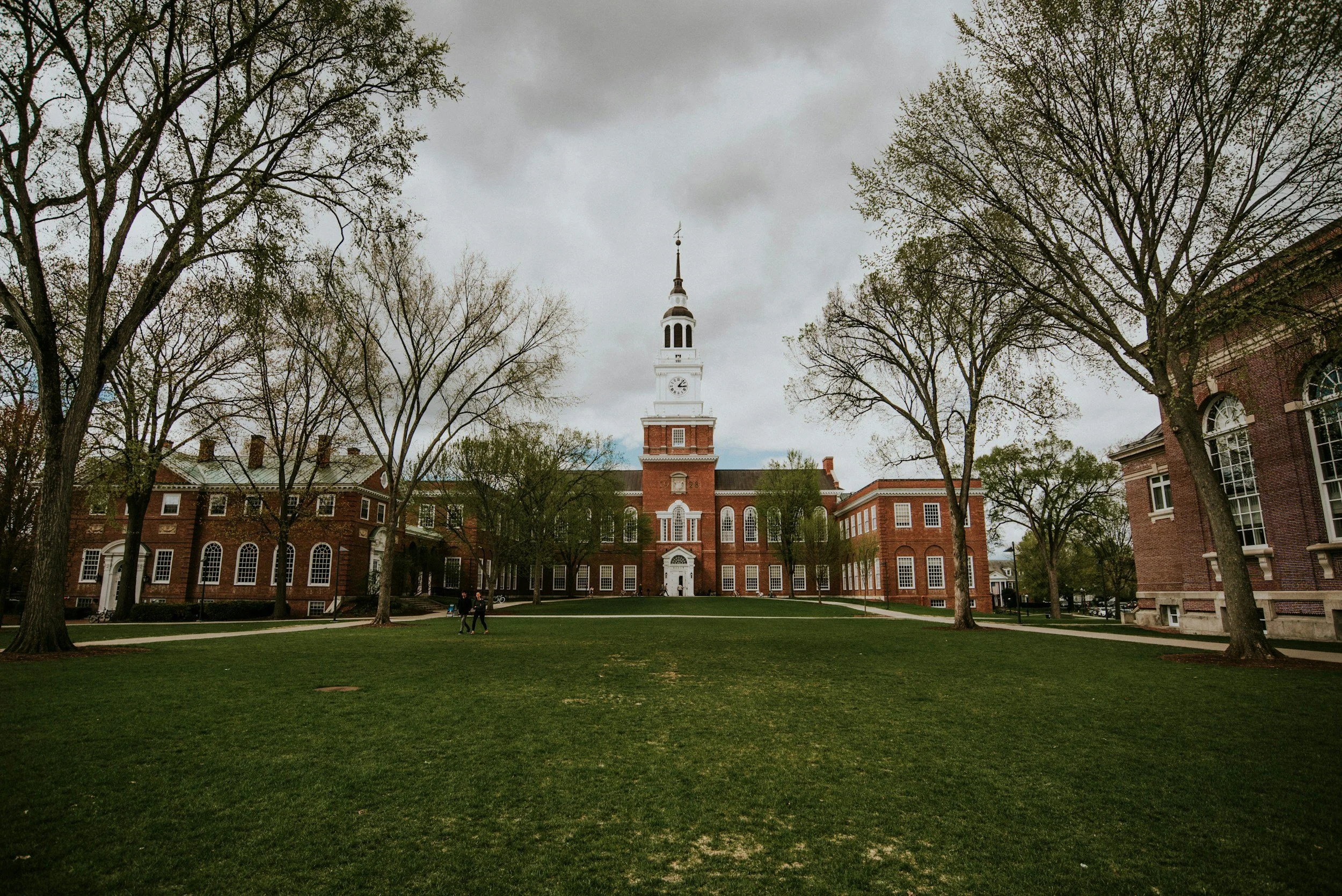
Dartmouth College has released its Common Data Set for 2025-2026, which offers the clearest available picture of who earns a place in its entering class. Below is what the latest figures reveal about Dartmouth's selectivity, the academic profile of its admitted students, exactly how Dartmouth weighs each part of an application, and how to position yourself for the 2026-2027 cycle. When we publish our Dartmouth supplemental essays guide for the 2026-2027 cycle, we will link it here.
A Sharper Look at Selectivity
Dartmouth remains one of the most selective universities in the world. For the class that entered in Fall 2025:
Applications received: 28,230
Students admitted: 1,699
Students enrolled: 1,205
Acceptance rate: roughly 6.0 percent
Fewer than one applicant in sixteen received an offer. Dartmouth also reports its applicant pool by residency, and the breakdown shows how international the competition has become. Of the 28,230 applicants, 8,163 applied from outside the United States, and 154 international students ultimately enrolled. Dartmouth does not break out its admit count by residency, so a precise international admit rate cannot be calculated from this year's data, but the size of that pool tells you the climb is steep from every direction.
The waitlist offers its own cautionary note. Dartmouth offered 2,497 applicants a place on the waitlist this year. It did not report how many accepted a spot or how many were ultimately admitted from it, which is itself the point: the waitlist is not something you can plan around, and you should build your list as though it does not exist.
The Academic Profile of Admitted Students
The credentials of Dartmouth's newest class look about how you would expect from a school at this level. Among enrolled students who submitted scores, the middle 50 percent landed in these ranges:
SAT composite: 1440 to 1550 (median 1520)
SAT Evidence-Based Reading and Writing: 720 to 770 (median 750)
SAT Math: 720 to 790 (median 770)
ACT composite: 32 to 35 (median 34)
ACT Math: 31 to 35 (median 33)
ACT English: 34 to 36 (median 35)
Submitted an SAT: 69 percent
Submitted an ACT: 33 percent
Dartmouth does not report an average GPA or a GPA distribution in this year's Common Data Set, but it does report class rank for the 44 percent of enrolled students whose schools provided one:
Ranked in the top tenth of their class: 96 percent
Ranked in the top quarter: 99 percent
A score inside the middle 50 percent, or a class rank near the top, does not set you apart at Dartmouth. It keeps you in the conversation.
Dartmouth Requires the SAT or ACT
Here is the policy difference that matters most, and it runs directly opposite to several of Dartmouth's Ivy peers. Dartmouth has reinstated its standardized testing requirement. For the current cycle, applicants must submit an SAT or ACT score. This is not test-optional, and there is no version of a Dartmouth application that is considered complete without a score unless you qualify for a hardship waiver.
A few specifics shape how you should approach this:
Students who attended high school in the United States must submit the SAT or ACT. There is no institutional preference between the two.
Students who attended high school outside the United States may satisfy the requirement in several ways, including national or regional exams such as A-Levels, the French Baccalaureate, or similar standardized national results.
Dartmouth superscores both the SAT and the ACT, taking your highest section results across test dates, so a weaker section on one sitting can be improved on a retake.
Scores must be received by February 1 for fall-term admission.
The practical takeaway is simple. Because the score is required and because Dartmouth rates it as one of its most important factors, testing is not a box to check at the last minute. Build a real preparation plan, take the test early enough to retake it if needed, and treat your score as a core piece of the application rather than an afterthought.
Who Makes Up the First-Year Class
Dartmouth's entering class of 1,205 first-year students draws from across the country and around the world. By share of the first-year class:
White: 49.8 percent
International (nonresident): 12.8 percent
Asian: 12.0 percent
Hispanic or Latino: 9.7 percent
Two or more races: 8.7 percent
Black or African American: 4.4 percent
Race or ethnicity not reported: 1.8 percent
American Indian or Alaska Native: 0.7 percent
Native Hawaiian or Other Pacific Islander: under 0.1 percent
How Dartmouth Weighs Each Part of Your Application
Dartmouth reads applications holistically, which means it evaluates the whole person rather than scoring a formula, and it reads each piece of your file in the context of the others and of the opportunities you actually had. The Common Data Set asks every college to rate how much each factor matters, on a four-level scale, and Dartmouth's answers tell you exactly where to put your energy.
Rated "Very Important":
Rigor of secondary school record
Class rank
Academic GPA
Standardized test scores
Application essay
Recommendations
Extracurricular activities
Character and personal qualities
Rated "Important":
Talent or ability
Rated "Considered":
Interview
First-generation status
Alumni relation
Geographic residence
Volunteer work
Work experience
Level of applicant's interest
"Not Considered":
State residency
Religious affiliation or commitment
Two patterns are worth pausing on. First, eight factors sit in the top tier, and they span both halves of the application. Six are academic, but extracurricular activities and character also rank as "Very Important," which tells you Dartmouth is not satisfied by numbers alone. It is building a community, and it weighs who you are alongside what you have achieved.
Second, standardized test scores sit in that top tier, and now that they are required, that placement is not theoretical. Unlike test-optional peers where a strong score is a lever you may or may not pull, at Dartmouth the score is both mandatory and heavily weighed. That makes it one of the few factors where preparation translates directly and predictably into a stronger file.
What the Top Factors Actually Mean
The eight "Very Important" factors are where applications are won and lost. Here is what each one signals to a holistic reader:
Rigor of secondary school record. Dartmouth looks first at whether you took the most demanding courses your school offered, such as honors, AP, IB, or advanced electives. This is judged relative to opportunity, so you are measured against what was actually available to you, not against students at better-resourced schools.
Class rank. Where you placed among your graduating peers signals whether your performance was exceptional in your own setting. Because many high schools no longer rank, Dartmouth weighs it when your school provides one, as confirmation that you operated at the top of your environment.
Academic GPA. Your cumulative grades show sustained performance across four years rather than a single strong moment. Strong grades keep you in the pool, but in a class where near-perfect transcripts are the norm, they rarely set you apart on their own.
Standardized test scores. Dartmouth requires a score and weighs it heavily. Its own research found that test scores, read against the norms of your specific high school, predict success at Dartmouth better than grades do, which is why the requirement came back. A score at or above its published range is a genuine asset.
Application essay. The essays are where a file stops being a set of numbers and becomes a person. Dartmouth reads them for voice, intellectual curiosity, and self-awareness, and in a holistic process they often carry the difference between two applicants with identical statistics.
Recommendations. Letters from your teachers and counselor give Dartmouth outside testimony about how you think, contribute, and treat others. They corroborate the picture you paint of yourself and add context you cannot credibly provide on your own.
Extracurricular activities. Dartmouth looks for depth, initiative, and real impact rather than a long list of memberships. What you did outside the classroom signals how you will engage with a tight-knit residential campus and what you will build once you arrive.
Character and personal qualities. Dartmouth treats who you are as seriously as what you have done. Integrity, resilience, kindness, and the way you affect the people around you surface through your essays, your recommendations, and your activities, and together they answer the question every holistic reader is really asking, which is whether they want you in the community.
How to Handle Demonstrated Interest
This is another place where Dartmouth differs from some of its peers. Dartmouth reports that it does consider an applicant's level of interest, which means signaling genuine enthusiasm is not wasted effort here. The single strongest way to demonstrate that interest is the one built into Dartmouth's admissions structure: applying through binding Early Decision, which tells the college you will enroll if admitted.
Beyond the early plan, a few low-effort steps are worth taking, all using the same email address you put on your Common Application so that any engagement is tied to your file:
Sign up for Dartmouth's admissions mailing list and newsletter.
Open the emails Dartmouth sends you and click through the links inside them.
Follow Dartmouth's official admissions and college accounts across social media.
Visit campus if you reasonably can, or join a virtual session or a local event if you cannot.
There is a second, more reliable payoff here. Engaging with Dartmouth's materials teaches you the specifics of its house communities, its D-Plan calendar, its undergraduate research culture, and the character of a small Ivy in rural New Hampshire, and that detail is exactly what turns a generic "Why Dartmouth" response into one that reads like it could only have been written by you. Because the application essay sits in Dartmouth's "Very Important" tier, the knowledge you absorb by paying attention pays off where it actually counts.
What This Means If You Are Applying
A few practical conclusions follow from the data. Pursue the most demanding curriculum your school offers and perform near the top of it, because rigor and grades are what keep you in contention. Build a serious testing plan early, since a score is required and weighed heavily rather than optional. Treat your essays as the centerpiece of the application rather than an afterthought, since this is where Dartmouth looks hardest for evidence of a distinctive mind. Build genuine relationships with the teachers who will write for you, so their letters can speak with specificity instead of generic praise. And commit deeply to a few activities rather than collecting many, because depth is what reads as talent and character.
None of this is about manufacturing a flawless profile. Dartmouth's emphasis on character, personal qualities, and the non-academic dimensions of an application reflects what it is genuinely looking for, which is students who will add something real to a small, close community rather than numbers that look impressive on paper.
The Cost, and Why It May Not Be What You Expect
The published price for the 2026-2027 year looks like this:
Tuition: $69,207
Required fees: $2,318
Food and housing on campus: $20,920
Books, transportation, and personal expenses: about $3,650 combined
Published total cost of attendance: roughly $96,100
That sticker price, though, is not what most families actually pay. Dartmouth's aid is among the most generous anywhere:
Demonstrated financial need met: 100 percent
Average need-based grant: about $73,800
Graduates who borrowed anything at all: about 27 percent, with an average cumulative principal of about $24,255
Dartmouth practices need-blind admission for every applicant, including international students, and meets the full demonstrated need of every admitted student regardless of citizenship. Its aid packages include no required loans, so what Dartmouth calculates as your need is met with grants and a modest student contribution rather than debt. Families with annual incomes below $125,000 and typical assets can expect a package with no parent contribution at all. If cost is a concern, run your family's numbers through Dartmouth's net price calculator before deciding the school is out of reach.
Life and Outcomes Once You Arrive
The data also speaks to what happens after you enroll:
First-year retention: 98 percent
Six-year graduation rate: 95 percent
Class sections with fewer than twenty students: about 61 percent
Student-to-faculty ratio: 8 to 1 (as reported in the Common Data Set)
First-year students living in campus housing: 100 percent
First-year students from out of state: 97 percent
Retention and graduation figures near the top of the national range point to students who arrive, stay, and finish, and the housing and residential community system anchors the close-knit culture Dartmouth is known for.
Deadlines and the Early Option
Unlike several of its peers, Dartmouth offers binding Early Decision rather than a nonbinding early plan. If Dartmouth is your clear first choice, this is the most powerful lever available to you:
Early Decision deadline: November 1
Early Decision decisions released: mid-December
Regular Decision decisions released: by early April
Reply deadline for admitted students: May 1
The strategic case is in the numbers. For the Fall 2025 class, Dartmouth received 3,552 Early Decision applications and admitted 768 of them, an Early Decision admit rate of roughly 21.6 percent. That is more than three times the overall acceptance rate of about 6 percent. Early Decision is binding, so it is only the right move when Dartmouth is genuinely your top choice and your application, including your test scores, will be ready in the fall. But when that is true, no other single decision moves your odds as much.
If you are preparing a Dartmouth application for the 2026-2027 cycle and want experienced guidance on the pieces that actually move the needle, schedule a consultation with an Ivy League admissions expert today.