Johns Hopkins Common Data Set 2025-2026
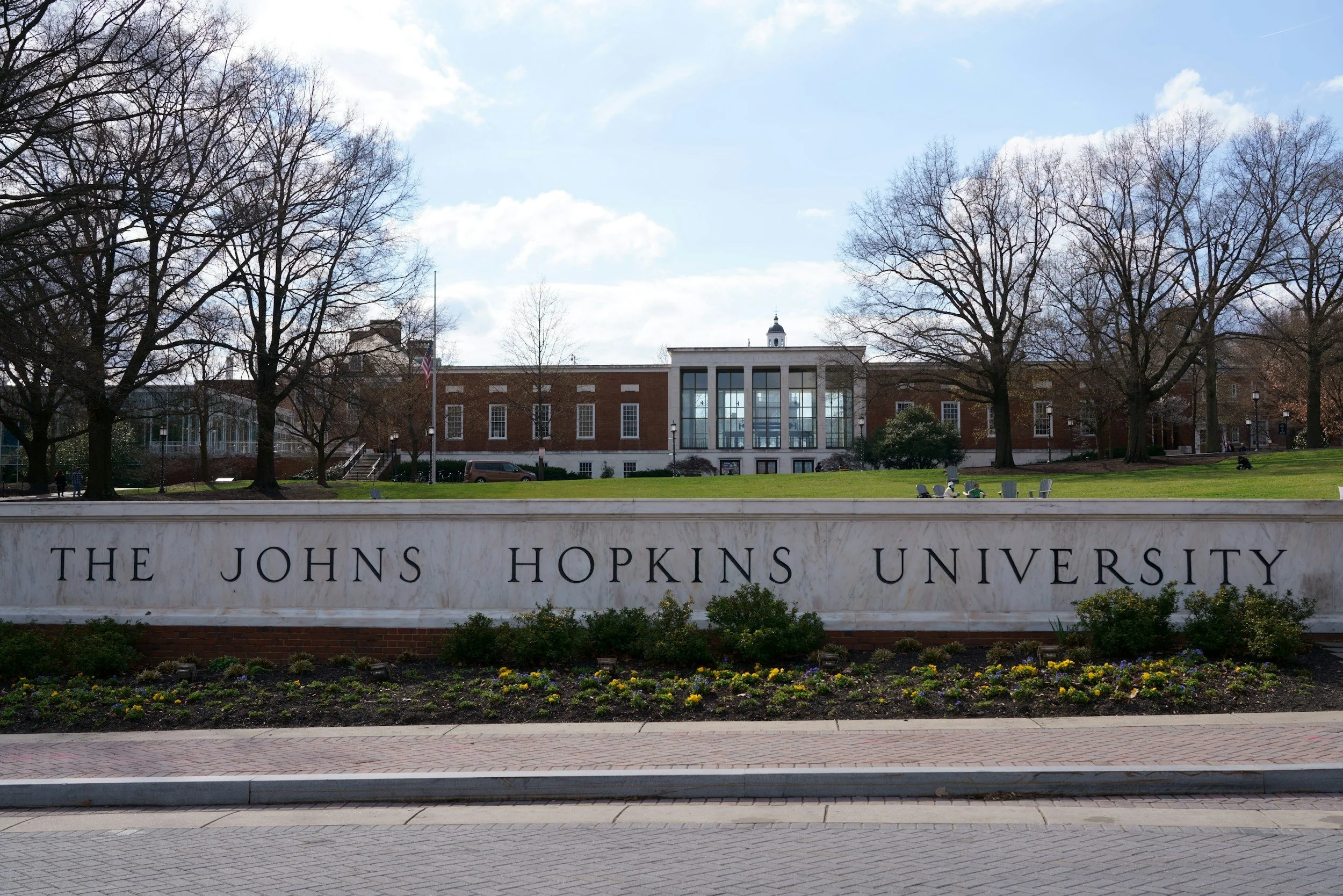
Johns Hopkins University’s 2025-2026 Common Data Set gives applicants a direct look at how selective Hopkins has become, what the university values most in admissions, how Early Decision affects the applicant pool, what test scores look like for enrolled students, and how financial aid changes the true cost of attendance.
Below is what the latest data reveals about Johns Hopkins admissions and what applicants should take away from it.
A Sharper Look at Johns Hopkins Selectivity
Johns Hopkins remains one of the most selective universities in the country. For the class entering in Fall 2025, the admissions section reports:
Applications received: 50,259
Students admitted: 3,072
Students enrolled: 1,378
Acceptance rate: roughly 6.1 percent
Yield rate: roughly 44.9 percent
That means Johns Hopkins admitted only about six students out of every hundred who applied. This is not a school where strong grades, rigorous coursework, and high test scores are enough by themselves. Most applicants who are academically qualified will still be denied.
The yield rate also matters. Nearly 45 percent of admitted students enrolled, which means Johns Hopkins has enough confidence in its applicant pool to shape a highly specific class.
Early Decision Matters at Johns Hopkins
Johns Hopkins offers Early Decision and does not offer Early Action. The Common Data Set reports:
Early Decision applications: 7,639
Early Decision admits: 835
Early Decision acceptance rate: roughly 10.9 percent
Early Decision I deadline: November 1
Early Decision I notification: December 11
Early Decision II deadline: January 3
Early Decision II notification: February 12
Early Action: not offered
By comparison, the overall admit rate was about 6.1 percent. If we subtract Early Decision from the total pool, the remaining applicant pool had about 42,620 applicants and 2,237 admits, an implied admit rate of about 5.2 percent.
That does not mean every student should apply Early Decision. The ED pool includes students with institutional hooks, recruited athletes, strong fit, and applicants who are often unusually prepared. But the data does show that Hopkins uses Early Decision as a major part of class-building.
If Hopkins is truly a student’s first choice, the application is ready by November, and the family understands the financial commitment of a binding plan, Early Decision deserves serious consideration.
The Academic Profile of Enrolled Students
Among enrolled students who submitted scores, Johns Hopkins reported one of the strongest testing profiles in the country:
SAT composite: 1530 to 1565, median 1550
SAT Evidence-Based Reading and Writing: 750 to 780, median 760
SAT Math: 780 to 800, median 790
ACT composite: 35 to 35, median 35
ACT Math: 34 to 36, median 35
ACT English: 35 to 36, median 35
Submitted an SAT: 57 percent
Submitted an ACT: 20 percent
The score distribution is even more revealing. Among enrolled students who submitted SAT scores, 99.4 percent had a composite score between 1400 and 1600. Among enrolled students who submitted ACT scores, 99.3 percent had a composite score between 30 and 36.
Johns Hopkins also reports GPA data:
Average high school GPA: 3.93
Percent submitting high school GPA: 95.86 percent
4.0 GPA: 66.09 percent
3.75 to 3.99 GPA: 25.36 percent
3.50 to 3.74 GPA: 5.53 percent
3.25 to 3.49 GPA: 2.04 percent
3.00 to 3.24 GPA: 0.76 percent
2.50 to 2.99 GPA: 0.23 percent
That means 91.45 percent of enrolled students who submitted GPA data had a GPA of 3.75 or higher. The academic baseline at Johns Hopkins is extremely high.
Test Scores Are Not Just “Considered” at Hopkins
One of the most important differences between Johns Hopkins and many other elite universities is how Hopkins reports standardized testing.
In the admissions factor table, Johns Hopkins rates standardized test scores as Very Important. Hopkins also reports that, for students applying for Fall 2027, SAT or ACT scores are required to be considered for admission to the Homewood Schools. For Peabody Conservatory, scores are not required but are considered if submitted.
That distinction matters. Many students still think of Hopkins through the broader test-optional era. But the 2025-2026 Common Data Set makes clear that testing is central to the Hopkins admissions process, especially for Homewood applicants.
The practical takeaway is straightforward:
Homewood applicants should treat SAT or ACT preparation as essential.
A score in the middle 50 percent range can strengthen the academic case.
A score far below the enrolled-student range will make admission more difficult.
Peabody applicants should follow the Conservatory’s separate testing policy.
At Johns Hopkins, testing is not a minor add-on. It is listed as one of the most important academic factors.
Who Makes Up the First-Year Class
In the enrollment section, Johns Hopkins reports 1,389 degree-seeking first-time first-year students. The racial and ethnic breakdown was:
Asian: 45.1 percent
White: 21.0 percent
International or nonresident: 13.5 percent
Hispanic or Latino: 10.1 percent
Two or more races: 4.1 percent
Black or African American: 4.0 percent
Race or ethnicity unknown: 2.1 percent
American Indian or Alaska Native: 0.1 percent
Native Hawaiian or other Pacific Islander: 0 percent reported among first-time first-year students
Johns Hopkins also has a national applicant pool. The residency breakdown for enrolled first-time, first-year students was:
In-state: 112
Out-of-state: 1,083
International: 183
The student life section reports that 90 percent of domestic first-year students were from out of state. Johns Hopkins is not primarily a Maryland regional school in its undergraduate admissions profile. It is a national and international university.
How Johns Hopkins Weighs Each Part of the Application
The admissions factor ratings are one of the most useful parts of the Common Data Set because they show what Hopkins itself says matters most.
Rated Very Important:
Rigor of secondary school record
Class rank
Academic GPA
Standardized test scores
Application essay
Recommendations
Rated Important:
Extracurricular activities
Talent or ability
Character and personal qualities
Volunteer work
Work experience
Rated Considered:
First-generation status
Geographic residence
Rated Not Considered:
Interview
Alumni relation
State residency
Religious affiliation or commitment
Level of applicant’s interest
The most important pattern is that Hopkins places every major academic factor in the highest tier: rigor, GPA, class rank, test scores, essays, and recommendations. That means the academic side of the application has to be exceptionally strong.
The second important pattern is that Hopkins does not treat extracurriculars as “Very Important” in the way some peer schools do. It rates extracurricular activities, talent, character, volunteer work, and work experience as Important. That does not mean they are unimportant. It means that at Hopkins, the academic case has to carry tremendous weight.
Demonstrated Interest Does Not Matter
Johns Hopkins reports that an applicant’s level of interest is Not Considered.
This is important. Visiting campus, opening every email, attending a webinar, or signing up for every admissions event is not listed as an admissions factor in the Common Data Set.
That does not mean students should avoid researching Hopkins. The reason to research Hopkins is not to “demonstrate interest.” The reason is to make better strategic choices and write a stronger application.
A strong Hopkins applicant should understand the university’s research culture, academic structure, major-specific opportunities, and collaborative intellectual environment. But the goal is not performative interest. The goal is substantive fit.
What the Top Factors Actually Mean
The six Very Important factors are where Johns Hopkins applications are won or lost.
Rigor of secondary school record. Hopkins wants students who took the most challenging courses available to them. AP, IB, honors, dual enrollment, advanced STEM courses, advanced humanities courses, and independent academic acceleration all matter in context.
Class rank. Hopkins rates class rank as Very Important, even though only 23.4 percent of enrolled first-year students submitted class rank. Among students who did submit class rank, 100 percent were in the top tenth of their high school class. If a student’s school does not rank, that does not automatically hurt them. But if rank is reported, Hopkins clearly expects elite standing.
Academic GPA. A 3.93 average GPA and more than 91 percent of reported GPAs at 3.75 or higher make clear that Hopkins expects consistent academic excellence.
Standardized test scores. Hopkins places test scores in the top tier. For Homewood applicants, scores are required for Fall 2027, and the enrolled student score ranges are extremely high.
Application essay. Hopkins rates the essay as Very Important. That means the essay is not decoration. It is a core part of the admissions file. The essay must show intellectual seriousness, maturity, specificity, and judgment.
Recommendations. Teacher and counselor letters matter significantly. Generic praise is not enough. The strongest recommendations show how a student thinks, contributes to class, approaches difficult problems, and functions in an intellectually demanding environment.
The Hopkins Applicant Strategy
A Johns Hopkins application should be built around academic depth.
The strongest applicants usually do not look like students who simply did everything well. They look like students who have a clear intellectual direction and the ability to pursue it at a high level.
For a biology, neuroscience, biomedical engineering, public health, or pre-med oriented applicant, that could mean research, clinical exposure, data analysis, science fair work, public health projects, or meaningful community health initiatives.
For a computer science, engineering, math, or physics applicant, that could mean advanced coursework, research, original technical projects, competitions, software development, robotics, or applied problem-solving.
For a humanities or social sciences applicant, that could mean research, writing, policy work, debate, publication, archival work, language study, or a serious intellectual project that shows depth.
The mistake many applicants make is treating Hopkins as a generic elite university. Hopkins is not generic. The most effective application should make it obvious why the student belongs in a research-intensive environment where academic seriousness is central.
The Waitlist Is Real, but Not a Plan
Johns Hopkins reports that it uses a waitlist. For Fall 2025:
Students offered a place on the waitlist: 2,058
Students accepting a place on the waitlist: 1,359
Students admitted from the waitlist: 247
Waitlist ranked: No
That means roughly 18.2 percent of students who accepted a place on the waitlist were eventually admitted.
This is higher than many students might expect, but the waitlist should still not be treated as a reliable backup plan. Waitlist movement changes year to year depending on yield, institutional priorities, and class composition.
Cost and Financial Aid
Johns Hopkins’ published 2026-2027 costs are high:
Tuition: $68,670
Required fees for first-year students: $500
Food and housing for first-year students: $21,967
Books and supplies: $1,377
Transportation: $738
Other expenses: $1,606
Estimated first-year total: about $94,858
That sticker price is not what every family pays. Hopkins reports that it meets 100 percent of demonstrated need on average for students who receive need-based aid.
For first-time, full-time first-year students receiving need-based aid:
Average financial aid package: $70,919
Average need-based scholarship or grant: $69,291
Average need-based self-help award: $2,209
Average need-based loan: $52
Hopkins also reports institutional financial aid for undergraduate nonresidents:
Nonresidents receiving institutional aid: 183
Average institutional aid award for nonresidents: $43,101
Total institutional aid awarded to nonresidents: $7,887,392
The loan data is also useful. Among 1,331 students in the 2025 undergraduate class who started at Hopkins as first-time students and graduated with a bachelor’s degree, 263 borrowed from some loan source. That is 20 percent of the class, with an average cumulative borrowed amount of $28,217 among borrowers.
A Major Financial Aid Policy Change
One of the most important financial aid details in the Common Data Set is Hopkins’ new affordability initiative.
Beginning with the Spring 2026 semester, undergraduate students in the School of Arts, Sciences & Engineering with family incomes up to $200,000 will receive at least full-tuition scholarships. Families earning up to $100,000 will also pay no living expenses.
That is a major policy change. Families who assume Hopkins is unaffordable based only on sticker price should run the net price calculator before ruling it out.
Life and Academics Once You Arrive
The Common Data Set also gives a picture of the undergraduate experience:
First-year retention rate: 97.83 percent
Six-year graduation rate: 93.4 percent for the Fall 2019 cohort
Student-to-faculty ratio: 9 to 1
First-year students living in college-owned, operated, or affiliated housing: 93 percent
Undergraduates living in college-owned, operated, or affiliated housing: 46 percent
Domestic first-year students from out of state: 90 percent
The class-size table in this year’s Common Data Set does not provide usable class-size interval data, so applicants should not rely on this CDS for a class-size breakdown.
Hopkins also reports a wide range of academic opportunities, including cross-registration, distance learning, double majors, dual enrollment, independent study, internships, student-designed majors, study abroad, teacher certification, undergraduate research, combined bachelor’s/master’s programs, and the double degree Bachelor of Arts and Bachelor of Music.
Popular Academic Areas
Johns Hopkins’ undergraduate degree distribution reflects its strength in science, engineering, health, and research-oriented fields.
The largest bachelor’s degree areas reported include:
Biological and life sciences: 23.2 percent
Engineering: 20.3 percent
Computer and information sciences: 10.5 percent
Social sciences: 10.5 percent
Health professions and related programs: 9.8 percent
Visual and performing arts: 6.3 percent
Interdisciplinary studies: 4.7 percent
Physical sciences: 3.7 percent
Mathematics and statistics: 3.5 percent
Psychology: 3.4 percent
This is one reason Hopkins attracts so many STEM, pre-med, public health, neuroscience, engineering, and research-oriented students. But the university is not only a science school. Its social sciences, humanities, music, writing, international studies, and interdisciplinary programs also play major roles in the undergraduate experience.
Deadlines and Application Logistics
Key dates and policies from the Johns Hopkins Common Data Set:
Application fee: $70
Fee waivers: available for applicants with financial need
Regular application closing date: January 3
Regular notification: by April 1
Reply deadline: May 1
Housing deposit deadline: May 29
Housing deposit: $200, nonrefundable
Deferred admission: allowed
Maximum postponement: 2 years
Early Decision I deadline: November 1
Early Decision I notification: December 11
Early Decision II deadline: January 3
Early Decision II notification: February 12
Early Action: not offered
If you are preparing a Johns Hopkins application for the 2026-2027 cycle and want experienced guidance on the pieces that actually move the needle, schedule a consultation with a T20 admissions expert today.